 EN

The Company Is Well-Known
Seeder Series
On 10 December 2025, Agripros (Beijing Worldlink Commerce Co., Ltd.), a one-stop agricultural machinery supplier based in Beijing, passed the UN Food and Agriculture Organization's multi-round qualification review, compliance due diligence and supply-chain capability assessment, and was named to FAO's list of qualified global suppliers.
The announcement is narrow in scope and specific in consequence. It does not describe a contract, a project or a volume. It describes a change in status: the company becomes eligible to bid for FAO humanitarian aid, agricultural development and international public procurement projects, where previously it would not have been considered.
That distinction matters, because the two are routinely conflated. Being qualified to bid is a statement about the supplier; winning a tender is a statement about a project. The qualification is what can be verified independently, and what changes what a buyer can do with the company.
FAO applies high-bar admission criteria to its global suppliers, covering enterprise qualification, quality management, global delivery capacity, social responsibility and compliance risk control. The list is recognized as one of the most demanding gateways in international public procurement.
The reason is structural rather than ceremonial. Public procurement has to justify a purchase to an auditor who was not present at the evaluation, which means a supplier's claims have to be evidenced in documents rather than demonstrated in a meeting. A qualification process built for that standard tests whether a supplier can produce the evidence.
For a manufacturer, admission therefore says something specific: not that the machines are the best available, but that the organization behind them can be audited, can trace a batch, can document a delivery and can be held to a compliance standard.
That is a narrower claim than marketing usually makes, and a more useful one — because it is the claim a procurement officer actually needs.
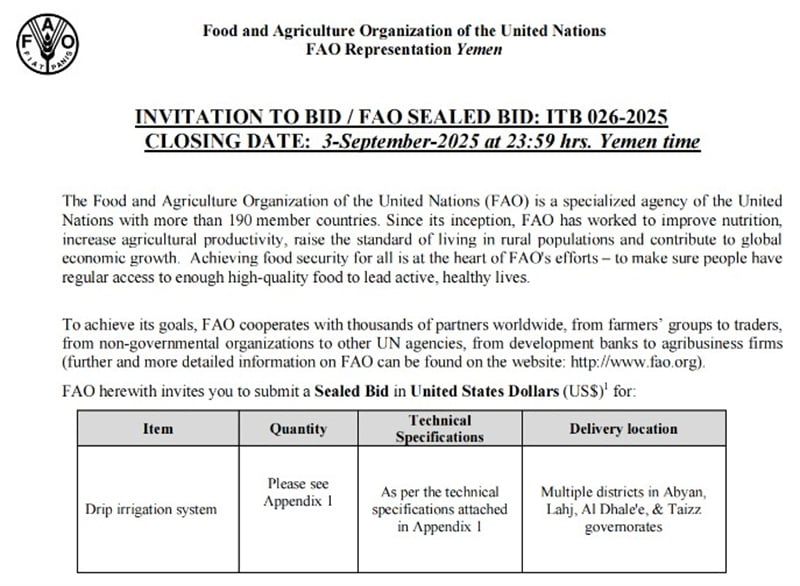
Caption: An example of an FAO invitation to bid (ITB 026-2025, FAO Representation in Yemen), shown as a document example rather than a contract held by Agripros.
The criteria read like a checklist and function as independent tests.
Enterprise qualification establishes that the supplier is a legal entity able to contract, and that the entity on the certificate is the entity that will invoice. Mismatches are common where supply chains run through intermediaries, and they matter because a contract signed with one entity cannot be enforced against another.
Quality management tests whether quality is a documented system rather than an inspection habit: procedures before the order, records after it, and a defined response when something deviates.
Global delivery capacity tests whether the supplier has moved goods across borders before, with the documentation, packing and logistics that entails — and whether the record can be evidenced rather than described.
Social responsibility tests whether operations meet the labour and environmental expectations attached to public funding.
Compliance risk control tests whether the supplier can identify and manage exposure — to sanctions, to fraud, to conflicts of interest — across a supply chain it does not fully own.
Each criterion can be passed or failed separately, which is why a strong product range does not compensate for a weak documentation system.
Manufacturers usually estimate a qualification process by the number of forms. The work is in the underlying systems, and it surfaces in a few predictable places.
Batch traceability. Being able to say which components went into which machine, and when, requires records created at assembly rather than reconstructed afterwards. Agripros describes standardised quality control from parts inspection and assembly testing through factory inspection and export packing, traceable and consistent across orders — a sequence that only holds if each stage leaves a record.
Document control. Certificates, test reports and declarations have to be current, correctly referenced and matched to the product actually shipped. An expired attestation attached to a sound machine is still a compliance failure.
Export packing and document accuracy. Packing that satisfies a commercial buyer may not satisfy a public procurement inspection. Descriptions, quantities and markings have to agree across invoice, packing list and certificate.
Delivery evidence. A delivery record is only useful if it can be produced years later, in the form an auditor accepts.
Most of this is invisible to customers. All of it is visible to an assessor.
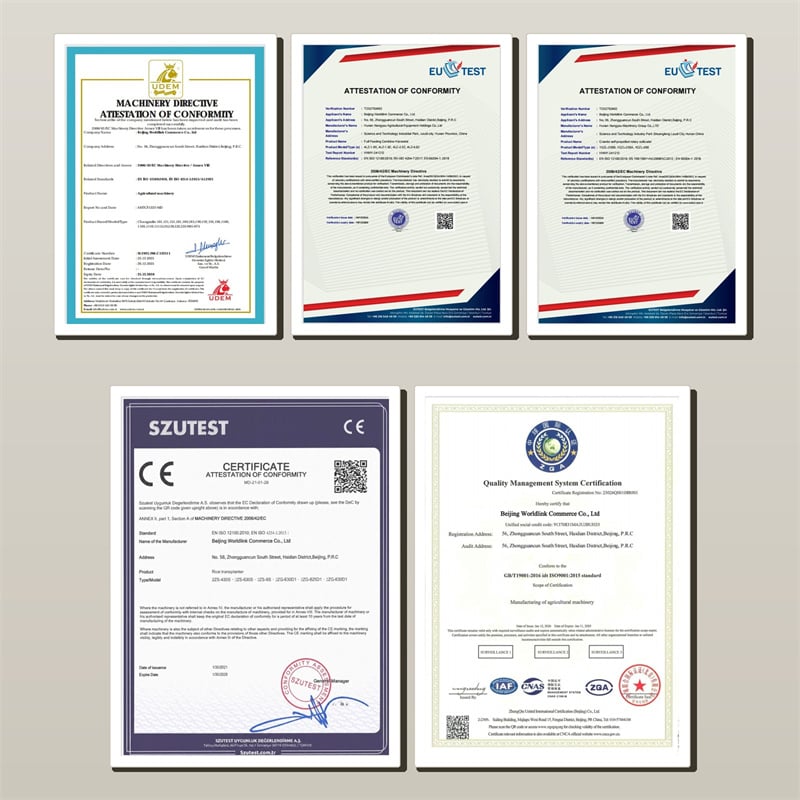
Agripros holds CE conformity attestations (EUTEST / SZUTEST / UDEM) and an ISO 9001 quality system. It is worth being precise about what those cover, because buyers often read them as a general warranty of quality.
A CE conformity attestation addresses conformity with applicable European requirements for the product it names. It is a statement about a product against a defined standard — not a statement about every product a company makes, and not a statement about field performance.
ISO 9001 addresses the quality management system: whether processes are defined, controlled and improved. It says an organization can be audited and can hold a process in place. It does not certify that a particular machine is well built.
Read together, they answer a procurement question rather than a farmer's question: can this supplier demonstrate conformity on the record, and is there a system behind the record? For a public buyer that is the relevant test. For a farm buyer, the relevant test is still the field.
Caption: CE conformity attestations (EUTEST / SZUTEST / UDEM) and ISO 9001 quality system held by Agripros (Beijing Worldlink Commerce Co., Ltd.).
Delivery capacity is the criterion most often misread by exporters, because it sounds like logistics and is actually evidence.
An assessor is not asking whether a company can book freight. The question is whether it has delivered into markets with different documentation regimes, and whether those deliveries can be evidenced: what shipped, to where, against which order, cleared by which authority, received by whom.
Agripros describes years of serving overseas agricultural markets as the basis for its knowledge of regional farming practices and export compliance, and positions that experience against the delivery and risk-management expectations of UN-level buyers. The practical content of that claim is familiarity with the points where shipments fail: an incorrect certificate, a packing mark that does not match the manifest, a specification that does not match the tender.
None of those failures is technical. All of them stop a delivery, which is why delivery capacity is assessed separately from product quality.
Being placed on the list is easy to undervalue because it is not a sale. Its function is to remove a category of risk before anyone has to evaluate a machine.
When a project buyer receives a supplier, the questions arrive in a fixed order: is this entity able to contract, is it compliant, can it deliver — and only then, is the equipment right. Qualification answers the earlier questions in advance. That is why a qualified supplier can be tabled in a procurement meeting where an unqualified one cannot be, however good the product.
There is a negative function as well. A qualification process filters out suppliers who cannot sustain documentation, which leaves a smaller and more comparable field. For a buyer, that reduction in search cost is a real benefit, independent of which supplier is eventually chosen.
The credential is not a claim of superiority. It is a claim of verifiability — and in public procurement, verifiability is the entry condition.
For a buyer, the qualification changes the order of the conversation rather than the conclusion.
It means compliance and documentation questions can be treated as answered at entity level, and attention can move to the machine: whether the configuration suits the soil and row system, whether the delivery schedule fits the season, whether parts are positioned for the first failure, and whether the service arrangement covers the district.
It also means Agripros can be placed inside a tender process rather than alongside it. Where a project requires a qualified supplier, an unqualified manufacturer cannot be specified however suitable its equipment; a qualified one can be, subject to the technical evaluation.
What it does not change is field performance. A qualification is evidence about an organization, not about a harvest. Buyers still need field records, references and a demonstration on their own ground — the qualification makes that evaluation possible rather than unnecessary.
With a place on the FAO list, Agripros can connect with FAO-led humanitarian programs, agricultural development initiatives and international public procurement tenders — bringing its equipment to projects that support global food security.
The categories involved carry different requirements. Humanitarian procurement is driven by urgency and standardisation: equipment has to be specified so that it can be delivered quickly and supported where it lands. Development programs are driven by sustainability and local capability, which puts weight on training and service. Public tenders are driven by documented compliance and price.
A supplier addressing all three needs a product range that can be configured rather than a single platform sold repeatedly. Agripros supplies planters and seeders, transplanters, tractors and tillage equipment through a complete one-stop agricultural machinery range — breadth that allows a project to be specified from one source, with the interfaces between machines owned by the same supplier.
Agripros states that it will follow UN procurement requirements, pursue FAO global cooperation opportunities, and support sustainable agriculture and food security with reliable machinery and professional service.
For buyers, the practical question is what to ask next. Three items are worth requesting: the product configurations relevant to the buyer's crops and soils, the delivery and documentation arrangements for the buyer's market, and the parts and service position that will apply after commissioning.
For a project that must justify a supplier to a funding body, the qualification answers the compliance question and leaves the technical one open — which is where evaluation should now begin.
Discover our advanced agricultural machinery, including seeders, sprayers, harvesters, and more. Designed for large plantations and farms, these machines boost productivity and efficiency worldwide. Explore product details, download manuals, and take the next step in agricultural innovation.


Expert teams ensure quick installation and seamless commissioning for all agricultural machines worldwide.

On-site and remote training programs empower operators for efficient and safe machinery usage.

Fast global shipping of genuine spare parts, guaranteeing machine uptime and operational continuity.

Round-the-clock expert support via phone and online channels for fast issue resolution globally.

