Where the loss happens
Rice transplanting punishes three things: seedling age, calendar drift and water depth. None of them shows up until the season is already decided.
Seedling mats that stay in the tray past their window lose vigour before they reach the paddy. Transplanting that slips by a week costs tillering that later nitrogen can only partly recover. And a machine that arrives with the wrong row geometry forces the buyer to either re-raise seedlings or plant at a spacing the local weeding practice does not support.
There is a measurable version of each. Before ordering, check five things on your own land:
-
Working width. Our four-row machine sets four rows at 238 mm on the standard 25 × 60 cm guide — a 952 mm planting span. The machine itself is 1,140 mm wide overall, and that is the number your bund gaps have to clear, not the span. If you order the narrower or wider guide, the span changes with it; check the span for the guide you order against the gap you actually have.
-
Headland room. The unit is 1,850 mm long. You need room at the end of the run to lift, turn and re-enter.
-
Standing water. Transplanting works in soft, flooded paddy; it does not work where water is deep enough to drown the working parts or where the surface will not carry the wheels. The shallow layer a freshly puddled field holds is the target; a field that needs draining before it can be planted is a drainage problem, not a machine problem.
-
Tray standard. Row spacing is set by the tray guide fitted to the machine, and your nursery has to raise mats that match it.
-
Seedling age. Mats have a window, and it is the age your local extension service specifies for the variety — not a fixed number that travels between regions. Work backwards from the transplant date you are aiming for.
Get those right and the operation is a schedule. Get them wrong and the machine is idle in the yard while the seedlings age.
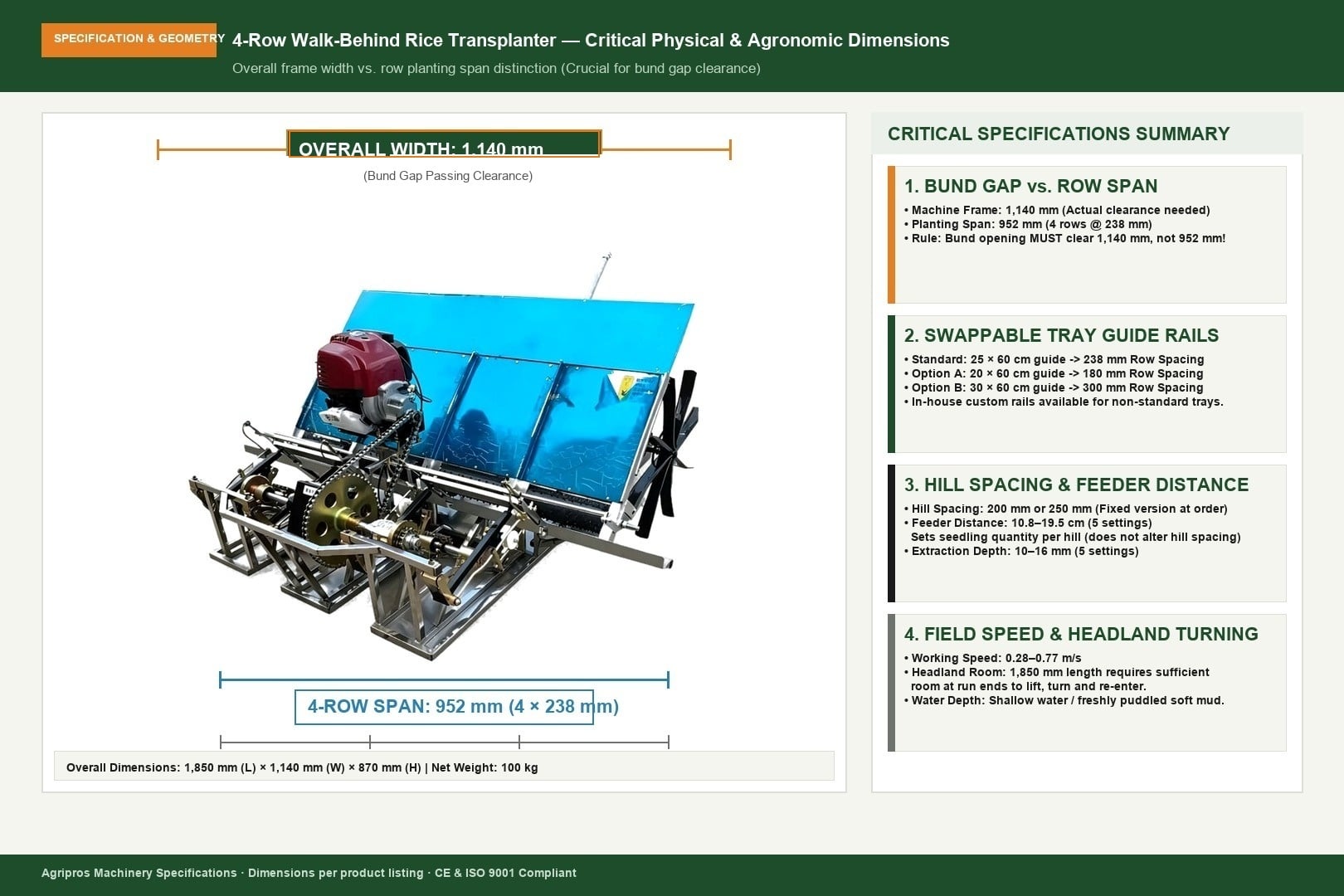
Machine frame width (1,140 mm) versus planting span (4 × 238 mm = 952 mm). The bund gap has to clear the frame, not the span.
The transplanting solution
We sell one rice transplanter platform, in three listing configurations. That is deliberate: a four-row walk-behind covers the plot sizes where hand transplanting is the binding constraint, and it is the configuration we can support with parts and service. The differences between the listings are the tray guide and the hill spacing, not the machine.
4-Row Walk-Behind Rice Transplanter (gasoline) — A 140F four-stroke gasoline engine, 2 HP at 6,800 rpm, running standard 92 octane fuel. Four rows at 238 mm spacing on the standard 25 × 60 cm guide, with hill spacing supplied as either 200 mm or 250 mm — two versions, chosen at order. Seedling extraction depth has five settings from 10 mm to 16 mm. Planting depth is adjustable and is set against your mat thickness; confirm the working range with us before the order rather than assuming it from the brochure.
Hill spacing and transplanting distance are two different settings, and the brochure does not make that clear. Hill spacing is fixed by the version you order — 200 mm or 250 mm. Transplanting distance is set in five steps from 10.8 cm to 19.5 cm, and it controls how much seedling mat is fed per hill, which sets the number of seedlings per hill. It does not change hill spacing. If you are calculating plants per square metre, the number you need is seedlings per hill, and that comes from the transplanting distance setting you choose.
The mechanism is gear-driven through a crank-rocker planting arm, with a front blade-type iron wheel (Ø600 mm standard, Ø510 mm optional). Working speed runs 0.28–0.77 m/s; planting frequency follows ground speed and the hill spacing ordered. Overall dimensions are 1,850 × 1,140 × 870 mm.
Two details decide whether it suits a farm. First, the walking position: the operator walks behind the machine, which is why it works in soft paddy where a riding unit would sink. Second, the tray guide: the standard configuration takes 25 × 60 cm mats at 238 mm row spacing, and 20 × 60 cm and 30 × 60 cm guides fit the same four-row frame at 180 mm and 300 mm. Custom guide rails are made in-house for non-standard trays. Row spacing follows the guide fitted — confirm your nursery's tray standard before the order is locked, because it is not a field adjustment.
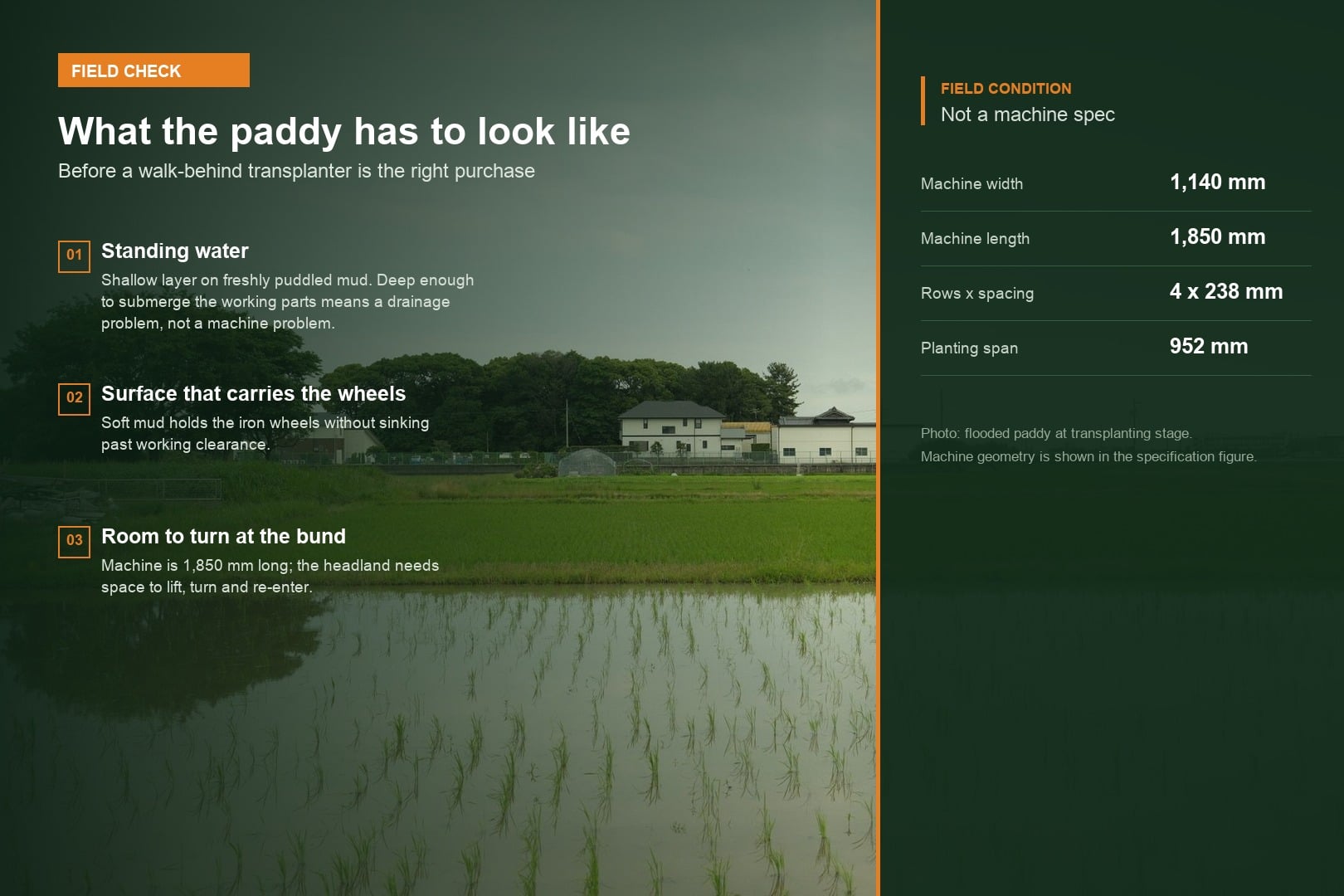
The field state this machine needs: shallow standing water over settled mud, and enough headland to lift and turn.
From transplanting to the mill gate
A transplanter on its own solves one operation and leaves four. That is why we quote the rice chain as a package: the buyer who mechanises transplanting usually hits the next constraint at harvest, and a machine bought alone tends to be replaced rather than extended.
The chain we can supply, in the order the season uses it:
-
Before transplanting — puddling and land preparation, 25–40 HP amphibious crawler tractor with a rotary tiller. Transplanting needs a puddled, levelled, settled field. Buyers who already own a crawler and a tiller can start at the transplanter; buyers who do not should plan this step first, because it decides whether the transplanter has a field to work in.
-
Field management — 25–40 HP amphibious crawler tractor. Paddy and orchard work where wheeled tractors bury themselves. It covers the land preparation and in-season passes between transplanting and harvest.
-
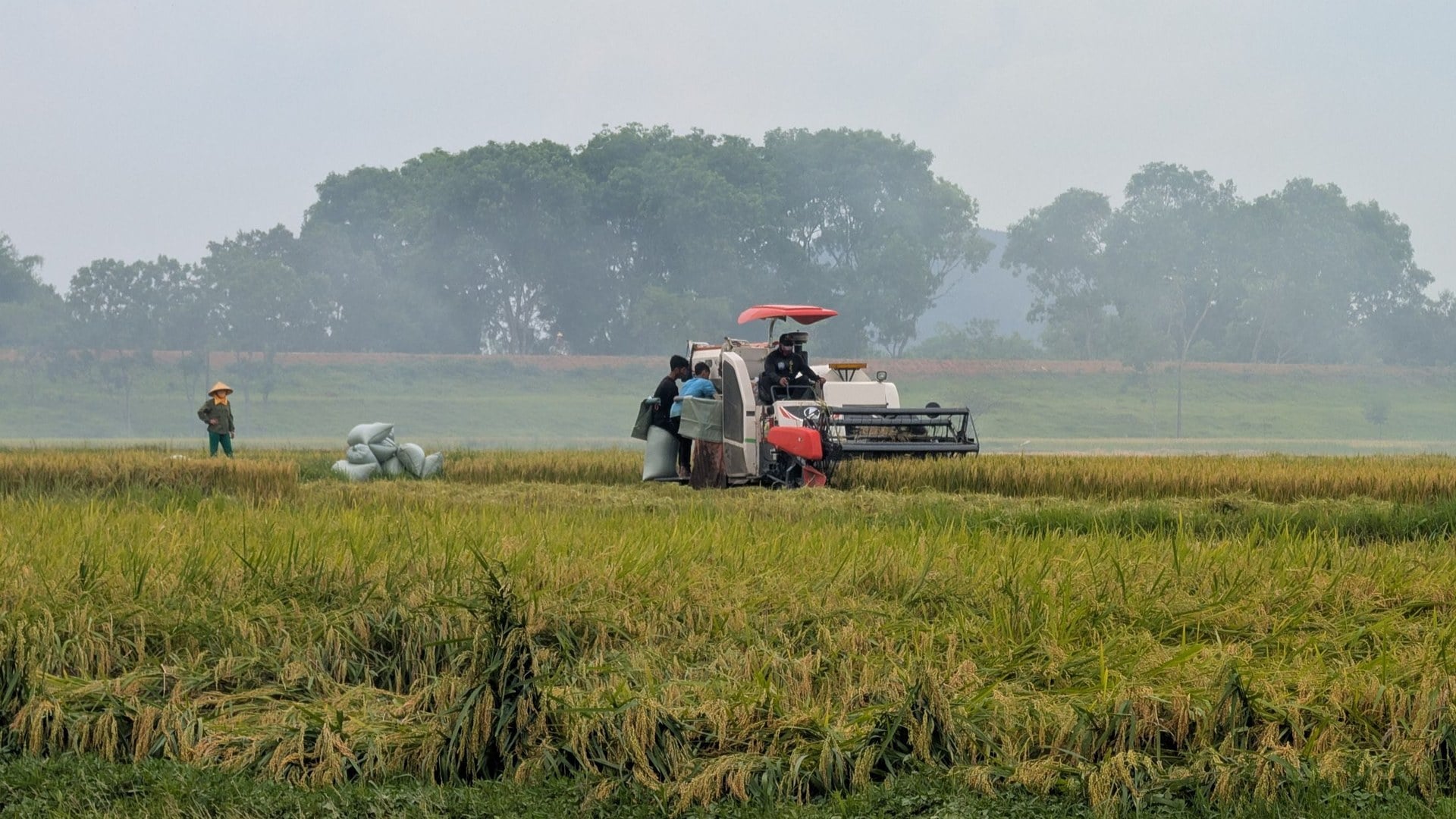
Harvest, small and terraced plots — mini crawler combine, 25 HP. A 1,200 mm cutting table on rubber crawlers, cutting, threshing, cleaning and collecting in one pass. Working capacity is listed at 0.13 ha/h and the unit weighs 1,000 kg, which keeps compaction low on wet ground. Listed for rice, wheat and small grains, and for paddy and terraced land where wheeled machines cannot operate.
-
Harvest, where binding and drying is the local practice — reaper binder, 500 mm cut, rice and wheat. Cuts and binds into sheaves for field drying, which is often how a smallholder without a dryer handles a wet harvest.
-
Post-harvest — diesel multi-crop grain thresher with double fan. For plots harvested by binder or by hand, where threshing is the bottleneck after the field work ends.
-
Water — 2–4 inch self-priming gasoline pump. For irrigation and drainage where the water source is a ditch, a well or a flooded corner rather than a canal.
Adjacent option — crawler combine, 102 HP, 2,200 mm cut. Model 482, Changchai 4G33TC four-cylinder water-cooled turbo diesel, 5,000 × 2,320 × 2,880 mm, 320 mm ground clearance, 0.42 m³ grain tank. We list it separately because the catalogue records it as a grain combine configured for corn: the rice threshing configuration has to be confirmed against your crop before ordering. It is here because the chassis and cut width suit large, drained blocks — not because the listing makes it a rice machine.
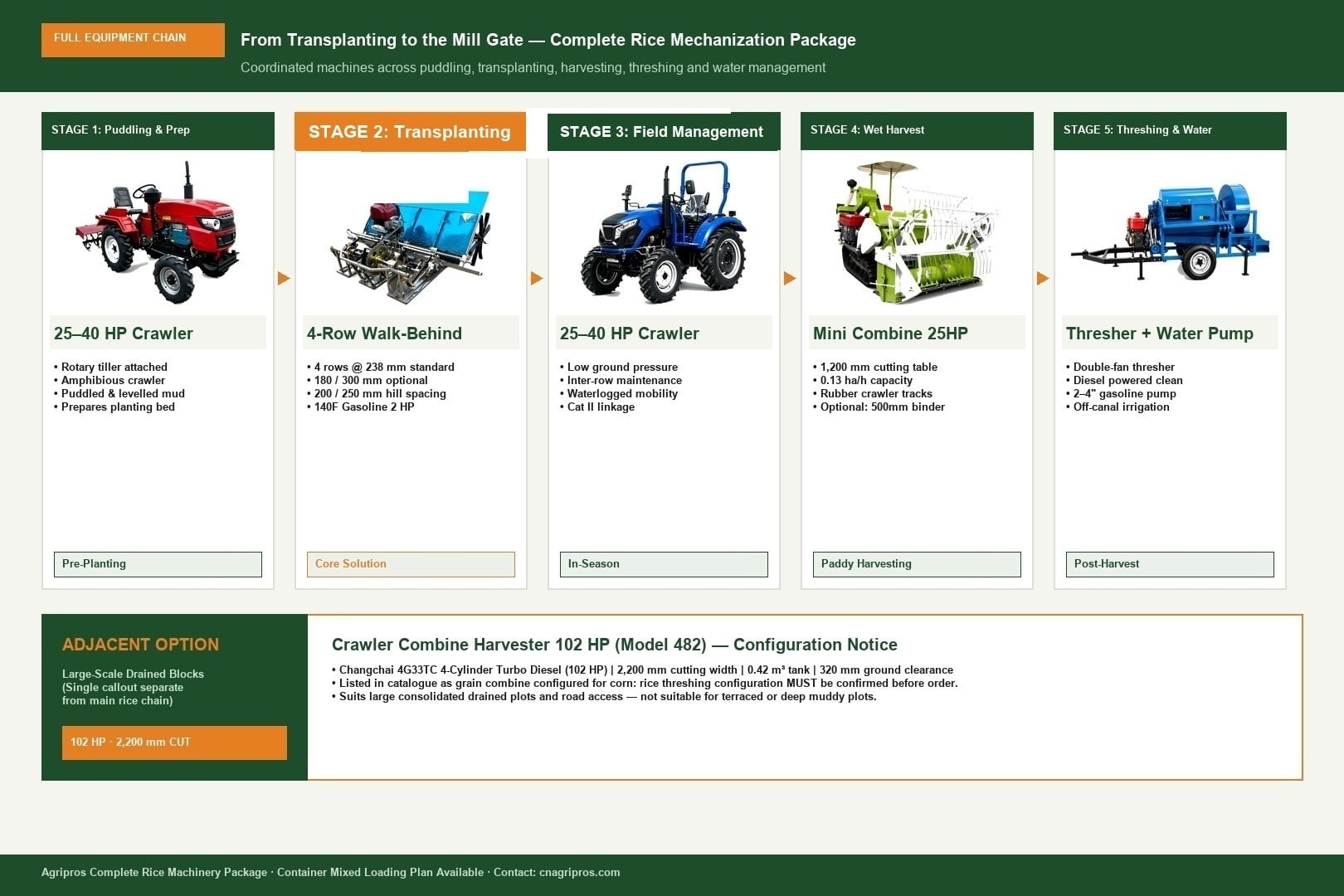
The rice chain we supply, from puddling to threshing. The 102 HP combine sits outside it, listed as an adjacent option.
Recommended equipment
| Operation |
Product |
Key specifications |
Why it fits |
| Puddling and land prep |
25–40 HP Amphibious Crawler Tractor + rotary tiller |
Crawler chassis | paddy and orchard use |
Transplanting needs a puddled, levelled field |
| Transplanting |
4-Row Walk-Behind Rice Transplanter |
4 rows | row spacing 238 mm standard (180 / 300 mm on alternative guides) | hill spacing 200 / 250 mm | 140F gasoline, 2 HP | depth adjustable |
Walks soft paddy, one operator, tray guides swappable |
| Field management |
25–40 HP Amphibious Crawler Tractor |
Crawler chassis | paddy and orchard use |
Keeps working where wheeled tractors bog down |
| Harvest, small / terraced |
Mini Crawler Combine 25 HP |
1,200 mm cutting table | 0.13 ha/h | 1,000 kg | CE |
Cut, thresh, clean and collect in one pass on wet ground |
| Harvest, bind-and-dry practice |
Reaper Binder |
2 rows | 500 mm cut | rice and wheat |
Sheaves for field drying without a dryer |
| Post-harvest |
Diesel Multi-Crop Grain Thresher |
Double-fan cleaning | diesel |
Handles binder or manual harvest |
| Water |
Self-Priming Gasoline Pump |
2–4 inch |
Irrigation and drainage off-canal |
Scenario × machine quick reference
| Your situation |
Field condition |
Machine |
What decides it |
| Household plot, terraced |
Soft, narrow, limited access |
4-row walk-behind transplanter |
Whether the bund gap clears the 1,140 mm machine width |
| Smallholder, lowland paddy |
Soft mud, small blocks |
4-row transplanter + 25 HP mini combine |
Harvest capacity of 0.13 ha/h against your area |
| Village service provider |
Scattered plots, mixed ground |
4-row transplanter, multi-plot routing |
Tray standard must match each customer's nursery |
| Cooperative, drained blocks |
Regular fields, road access |
102 HP crawler combine (adjacent option) |
Whether the block justifies a 2,200 mm cut, and whether rice configuration is confirmed |
| Wet harvest, no dryer |
Humid, late-season rain |
Reaper binder + thresher |
Drying capacity, not harvest speed |
When this is not the right machine
We would rather lose the order than place a machine that sits.
Do not buy the four-row transplanter if:
-
Your bund gaps are narrower than about 1.2 m. The machine is 1,140 mm wide overall; the four rows span 952 mm on the standard guide. A gap that clears the rows but not the frame will not let the machine through.
-
Your paddy cannot be brought to soft mud. The machine is built for flooded, puddled ground. Where the surface is baked or stony, it will not plant at depth.
-
You farm blocks large enough to need a riding machine. We do not offer a riding transplanter. Above the scale where a walking operator can keep up, the honest answer is a contractor or a different supplier, not a bigger engine on a walk-behind.
-
You direct-seed. If your system is dry direct-seeded rice, you do not need a transplanter — you need a paddy drill, which is a different machine from a maize precision seeder: shallow placement, narrow rows, high seed rate, and a metering system that tolerates damp conditions. Tell us your system and we will say plainly whether we can supply it.
-
Your nursery cannot raise mats to a fixed tray standard. Row spacing is set by the tray guide. A nursery cutting mats to its own dimensions will fight the machine every season.
Do not buy the 25 HP mini combine if your blocks are large and drained and you need throughput; that is the 102 HP machine's territory. Do not buy the 102 HP combine for terraced or waterlogged plots where a 2.2 m cut cannot be manoeuvred, and do not order it for rice without confirming the threshing configuration first.
For dealers and importers
This is the section most supplier pages leave out, so here are the numbers you need to quote a customer.
MOQ. One set on standard models. OEM orders start at 10 pcs for the transplanter.
Lead time. 20 days for one set; larger quantities confirmed at order. The 102 HP combine runs 20 days for 1–30 sets, with schedules above that agreed against the order.
Packing and loading. The transplanter ships one set per package at 185 × 114 × 87 cm, 100 kg gross, in reinforced steel-frame export packing inside a crate. That package size is what you plan a mixed container against; the final loading plan is confirmed per order with your mix. Ports of loading are Guangzhou and Qingdao.
Spare parts. A wearing-parts kit ships with every machine — seedling pick-up claws and drive belts. Warranty parts go out free by DHL or TNT within 48 hours, subject to stock and destination, and core transplanter models are supported with parts for up to 10 years. The gearbox and motor are modular and can be replaced on the farm rather than shipping the unit back.
Warranty. One year on all machines.
Trade terms. FOB, with CFR and CIF confirmed per order.
Mixed loading. The commercial argument for the package is here: a dealer ordering transplanters can put a mini combine or a pump set in the same shipment and offer a rice line rather than a single machine. Tell us the mix and the destination port and the loading plan comes back with the quotation.
OEM. Label, brand colour, logo on machine and packaging, and a specification sheet in your language. Custom tray guide rails are made in-house for non-standard trays.
For project and institutional buyers
Tender evaluation asks different questions, and the answers here are documentary rather than descriptive.
Certification. The transplanter listing records CE and ISO 9001. The 102 HP combine is listed with CE marking and states compliance with EU standards; the 25 HP mini combine is listed with CE. We state certification per model rather than as a company-wide claim, because a tender is evaluated per line item.
Inspection documents. Machinery test report and video outgoing inspection are available for the combines, together with CE documentation for the 102 HP unit. Pre-shipment inspection by a third party can be arranged.
Delivery record. Where a programme requires evidence of prior supply, we provide shipment records and reference contacts against the specific product being tendered, not a general company profile. Availability is confirmed per project and product before it is offered in a bid.
Acceptance documentation. English operation manual and specification sheet ship with every machine; other languages on request. That is the set a project needs at handover, and it is the set that usually goes missing on informal purchases.
Training. Video training over WhatsApp from our engineers, with on-site engineer dispatch available on request.
FAQ
What is your MOQ and lead time?
One set on standard models, 20 days for a single set. Larger quantities are scheduled at order, and OEM runs start at 10 pcs.
How do you handle shipping and containers?
The transplanter packs one set per 185 × 114 × 87 cm crate at 100 kg gross; we confirm the loading plan against your actual mix and destination port. Loading is from Guangzhou or Qingdao.
What are the payment and trade terms?
FOB as standard, with CFR and CIF quoted per order. Payment terms are confirmed with the order; orders through Trade Assurance carry the platform's payment protection.
What does the warranty cover, and how fast are parts?
One year on all machines. Warranty parts ship free by DHL or TNT within 48 hours, subject to stock and destination, and core transplanter models are supported for up to 10 years. Gearbox and motor are modular for on-farm replacement.
Can you put our brand on the machine?
Yes — label, colour, logo on machine and packaging, and a specification sheet in your language. OEM from 10 pcs.
Do you supply the whole rice line or only transplanters?
The line: puddling and land prep, transplanting, field management, harvest, threshing and water. That is the point of buying from one supplier — the interfaces between the machines become our problem rather than yours.
Which tray standard should I order?
The standard configuration takes 25 × 60 cm mats at 238 mm row spacing. 20 × 60 cm and 30 × 60 cm guides fit the same four-row frame at 180 mm and 300 mm, and custom rails are available. Row spacing follows the guide, so confirm your nursery's standard before the order.
200 mm or 250 mm hill spacing?
Two versions are built. Hill spacing is a machine specification, not an adjustment — choose it against your local agronomic recommendation and your weeding practice. It is separate from the transplanting distance setting, which controls seedlings per hill.
Will it work in deep mud?
It works in soft, flooded paddy. It will not work where water is deep enough to submerge the working parts or where the surface cannot carry the wheels. If your field is deeper than that, the constraint is drainage, not machine power.
Not sure which configuration fits your farm?
Send four things and the answer comes back configured rather than generic: plot size and shape, whether the paddy is soft or firm, your tray standard, and your harvest and drying practice.
- We return a configuration, a quotation and a loading plan within one working day.
- Optional: a video inspection of the machine before shipment, or a conversation with a buyer already running it in your region.
- If the honest answer is that a machine does not fit your conditions, we will say so before you order.
Contact us → /contact-us
 EN