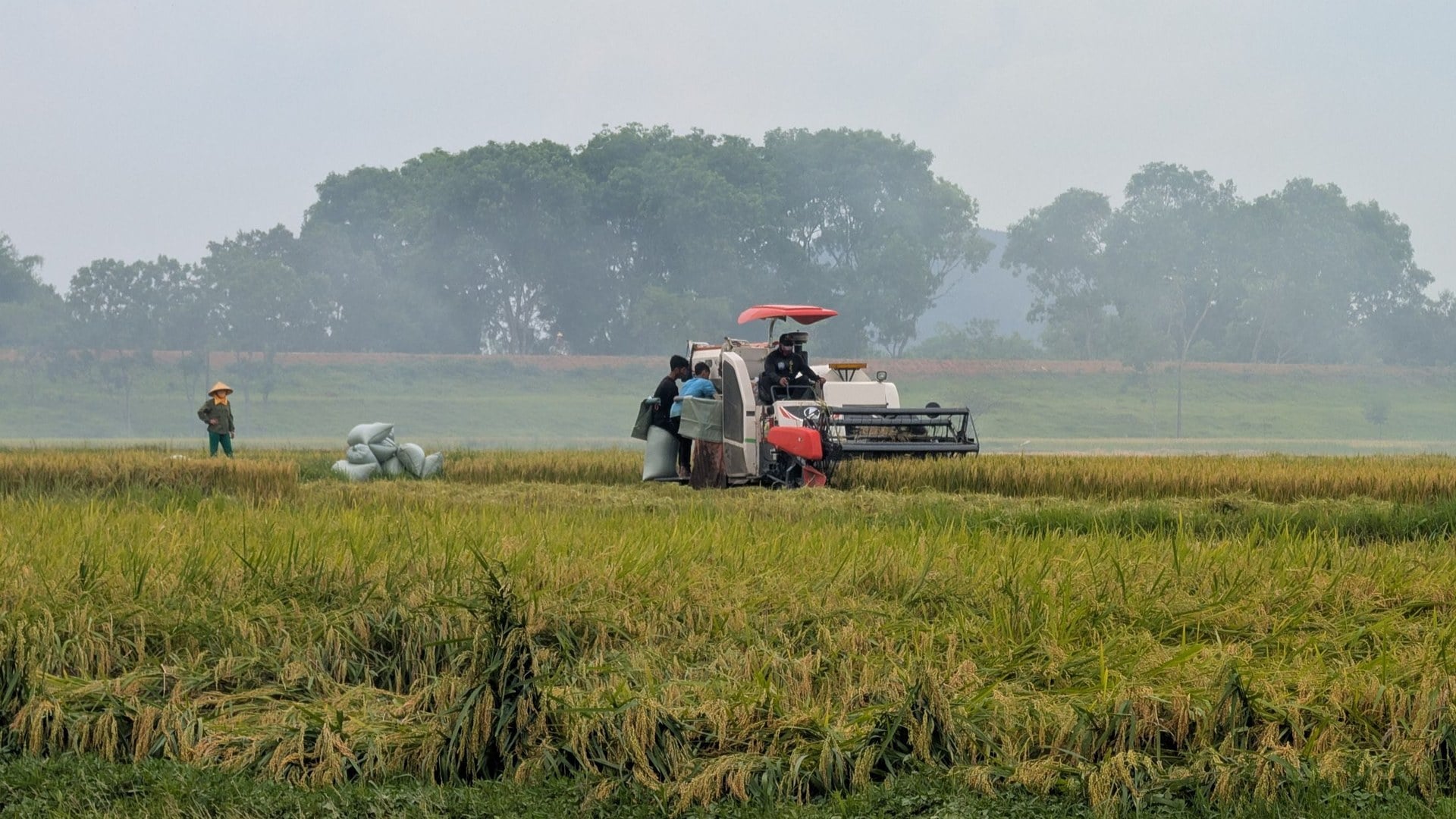
Garlic is planted as a clove, not a seed, and that single fact sets the economics of the whole operation. Every clove has to be separated from the bulb before planting — work done by hand on most farms, and the reason garlic remains one of the last crops where planting labour still dominates the cost sheet.
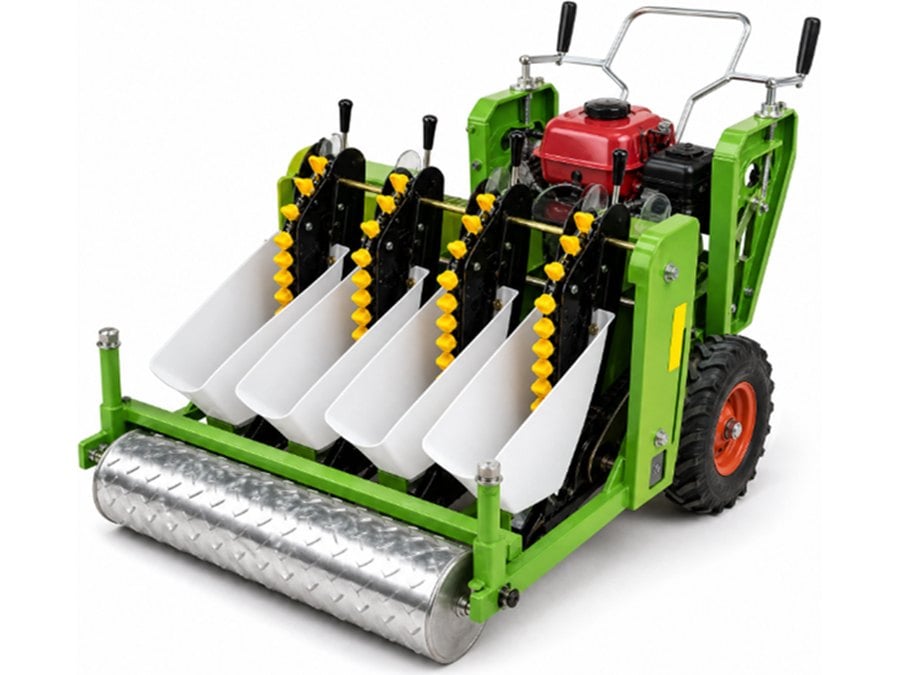
The second loss is emergence. A clove that does not sit in firm contact with soil dries out or rots before it roots. A press roller levels and presses the soil in the same pass, so sowing, levelling and compaction finish in one operation; without it the soil over the clove stays loose, and the difference shows up as an uneven stand rather than a single bad day.
The third is depth. Garlic wants to sit shallow. The machine's sowing depth adjusts from 0 cm to 6 cm, but that is the travel of the depth control, not a recommendation: local practice for your clove size and soil usually sits inside the middle of that range, and it should be set before planting rather than adjusted across the field. A depth that drifts produces a crop that emerges over two weeks instead of one, which then cannot be irrigated or lifted as a single block.
The fourth is clove size. Seed lots differ between varieties and between seasons, and a spacing set for one lot will over- or under-place the next. This is why the machine sets clove spacing through a gearbox rather than a fixed plate.
The planting solution
We sell one garlic planter platform in three row counts, and the row count is chosen against bed width rather than against farm size. The three models are 232-2-1 (3-row, working width about 48–66 cm), 232-2-2 (4-row, about 64–88 cm) and 232-2-3 (5-row, about 80–110 cm). All three are self-propelled on a 7.5 HP gasoline engine.
The settings that decide whether it suits your field:
-
Row spacing 16–22 cm, adjustable. Left/right row-spacing adjusters move the units; the row units themselves are modular, so the planter is matched to local agronomy instead of the field being forced to match the machine.
-
Sowing depth 0–6 cm on a single depth control. One setting for the whole bed, made before planting. Even depth across the bed is what produces a stand that emerges together.
-
Clove spacing by 6-speed gearbox. Six gears set plant spacing, while a separate shift gearbox sets travelling speed — the two are independent, which is what lets one machine adapt to different clove sizes and soil conditions without changing parts.
-
Sowing-spoon metering, one hopper per row. Sheet-steel hopper above spoon-type metering on every row unit gives a continuous, controlled supply and single-clove placement instead of a random scatter.
-
Flower press roller, standard. Levelling and compaction in the same pass.
Output scales with row count: 1.5–2.5 mu/h on the 3-row, 3–4 mu/h on the 4-row and 2–5 mu/h on the 5-row. One mu is about 667 m², so the 4-row works at roughly 0.20–0.27 ha/h.
Two limits are worth stating before an order. First, cloves must be separated from the bulb: no machine in this category plants whole bulbs, and any supplier who claims otherwise is describing a different crop. Second, spoon metering delivers one clove per drop — it does not guarantee that the clove lands point-up. Mechanical garlic planters generally do not orient the clove, and a page that claims otherwise is worth questioning on the demonstration.
Recommended equipment
| Bed width |
Product |
Rows |
Key specifications |
Why it fits |
| Narrow beds |
Garlic Planter 3-Row Self-Propelled (232-2-1) |
3 |
7.5 HP gasoline | 48–66 cm working width | 16–22 cm row spacing | 0–6 cm depth | 1.5–2.5 mu/h |
Lowest input cost per pass; matches beds that will not take a wider unit |
| Standard beds |
Garlic Planter 4-Row Self-Propelled (232-2-2) |
4 |
7.5 HP gasoline | 64–88 cm working width | 16–22 cm row spacing | 0–6 cm depth | ~0.20–0.27 ha/h |
The usual starting point for garlic grown as a cash crop |
| Wide beds |
Garlic Planter 5-Row Self-Propelled (232-2-3) |
5 |
7.5 HP gasoline | 80–110 cm working width | 16–22 cm row spacing | 0–6 cm depth | 2–5 mu/h |
Highest output per pass where the bed and the labour gang can keep up |
Other row counts, other bed widths and OEM branding are available on request; the configuration is confirmed against your bed width before quotation.
Scenario × planter quick reference
| Your situation |
Bed width |
Recommended model |
Rows |
What decides it |
| Household plot, hand planting today |
Under 50 cm |
232-2-1 |
3 |
Entry cost; one operator can keep pace with the bed |
| Small commercial grower |
60–90 cm |
232-2-2 |
4 |
Output of roughly 0.20–0.27 ha/h against your planting window |
| Cash-crop grower, tight window |
80–110 cm |
232-2-3 |
5 |
Whether the separation crew and the field can feed a wider pass |
| Mixed varieties, changing clove size |
Any |
Any of the three |
3–5 |
The 6-speed gearbox: spacing is re-set by gear, not by part |
| Contract planting across plots |
Any |
232-2-2 or 232-2-3 |
4–5 |
Transport width and the ability to re-set between fields |
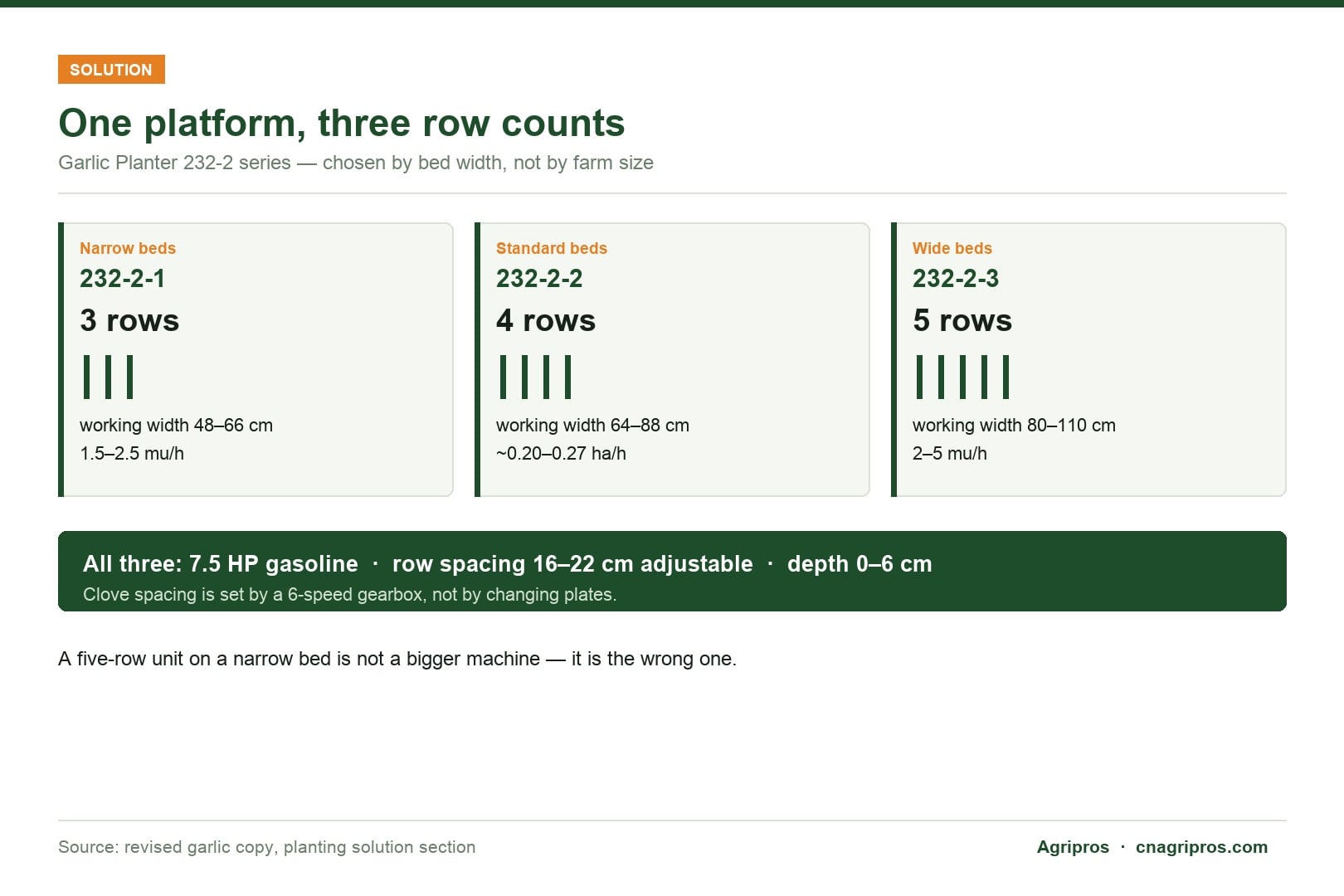
▲ Three-row, four-row and five-row garlic planters on the same platform
From inquiry to first pass
Five answers fix the model: bed width, planted area, target row spacing and depth, soil type, and how cloves are separated. Bed width decides the row count before anything else, because a five-row unit on a narrow bed is not a bigger machine — it is the wrong one.
Two of those answers change the setting rather than the model. On sandy soil the press roller matters more than the row count; and where cloves are separated mechanically rather than by hand, clove damage is higher and depth control should be set more conservatively.
Each planter ships in an export wooden case of about 150 × 100 × 100 cm, from Guangzhou or Qingdao on FOB, CFR or CIF terms. Container loading is confirmed in the quotation against the model mix and destination, because the case volume differs between the three row counts and a mixed order does not fill a container the same way a single-model order does. A manual and a spare parts list travel with each unit.
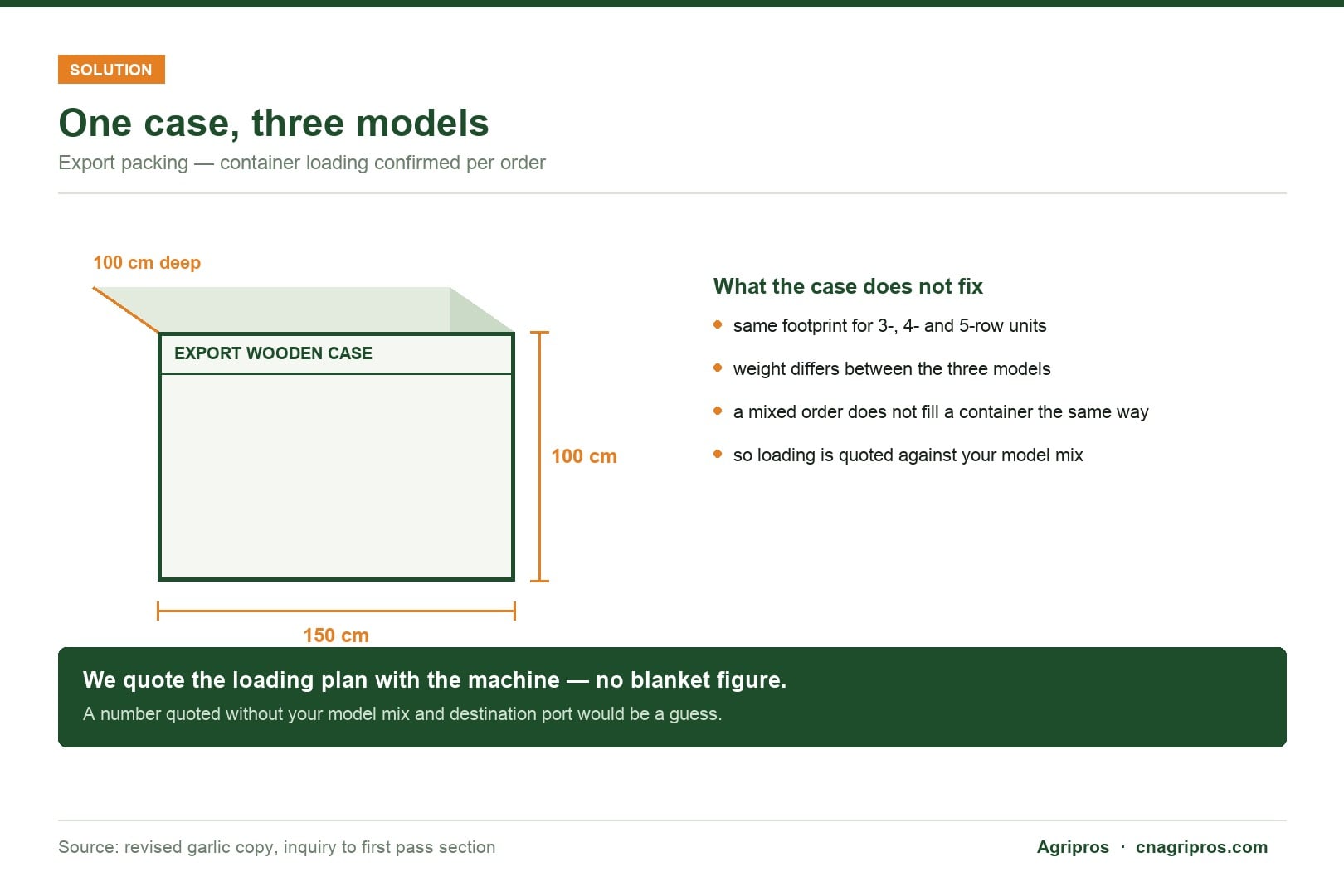
▲ Three-row, four-row and five-row units crated for loading
FAQ
Which of the three row counts should I order?
Choose by bed width: 232-2-1 (3-row, 48–66 cm) for narrow beds, 232-2-2 (4-row, 64–88 cm) for standard beds, 232-2-3 (5-row, 80–110 cm) for wide beds. Area decides how many passes you run, not which model you buy.
How is row spacing adjusted?
Between 16 cm and 22 cm using the left/right row-spacing adjusters. Row units are modular, so the setting is mechanical rather than a fixed plate.
What sowing depth should I use?
The machine adjusts from 0 cm to 6 cm. That is the range of the control, not a recommendation — set depth for your clove size and soil before planting, and keep one setting across the bed.
Does it plant the clove point-up?
No. Spoon metering places one clove per drop; it does not orient the clove. Mechanical garlic planters generally do not orient, and the practical answer is a well-prepared, firm seedbed plus a press roller, which is what the stand depends on.
Do I have to separate the cloves first?
Yes. Every mechanical garlic planter plants separated cloves; this is not a limitation of a particular model. Plan labour for separation whichever machine you buy.
How many fit in a container?
Loading is confirmed per order against the model mix and destination. The three models ship in the same footprint case (about 150 × 100 × 100 cm) but differ in weight and in how they stack, so a mixed container is quoted rather than assumed.
Not sure which configuration fits your farm?
Bed width, soil and labour availability differ from farm to farm. Send us your bed width, planted area and target row spacing, and we return the model, the settings and a loading plan.
- Tell us your bed width, planted area, soil type and how you separate cloves.
- Receive a model recommendation with a quotation within one working day.
- Optional: a video inspection before the season, or a conversation with a grower already planting with the machine.
Product page: /garlic-planter-3/4/5-row-self-propelled-gasoline-seeder
Contact us: /contact-us
 EN