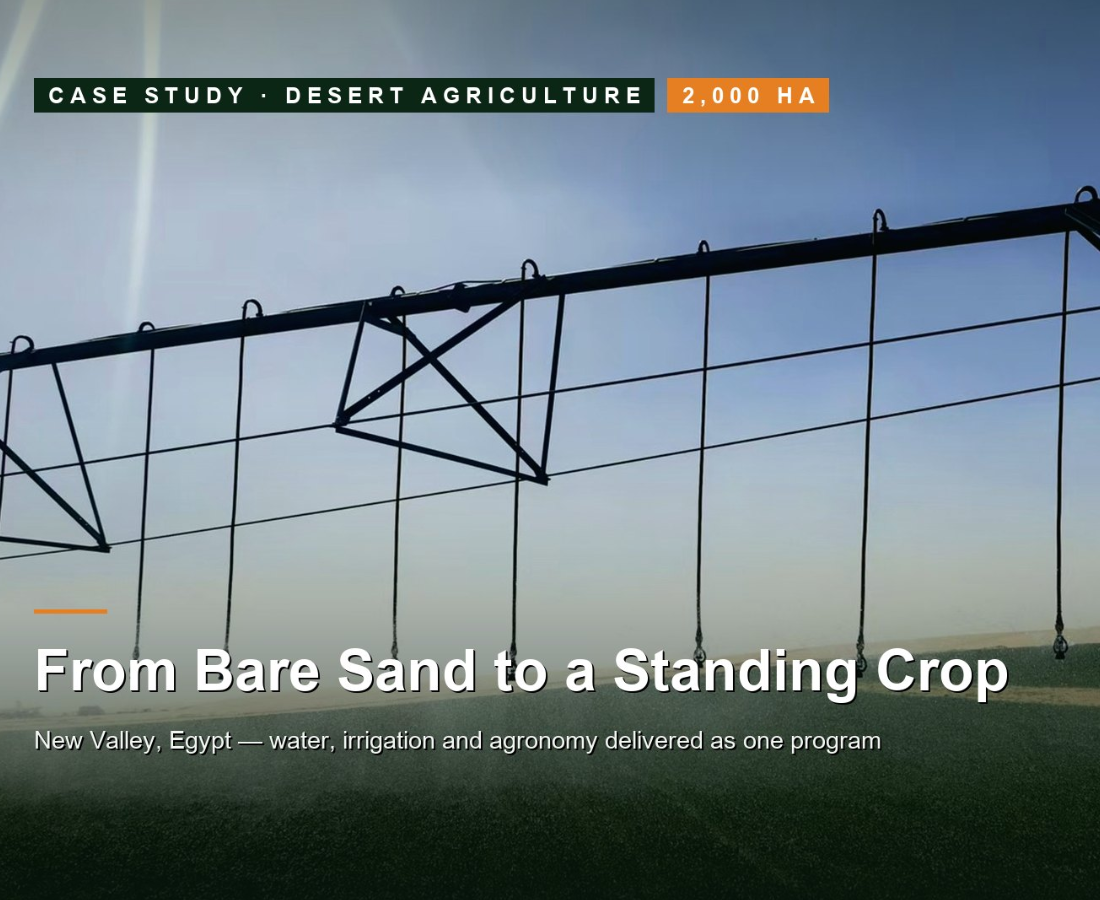
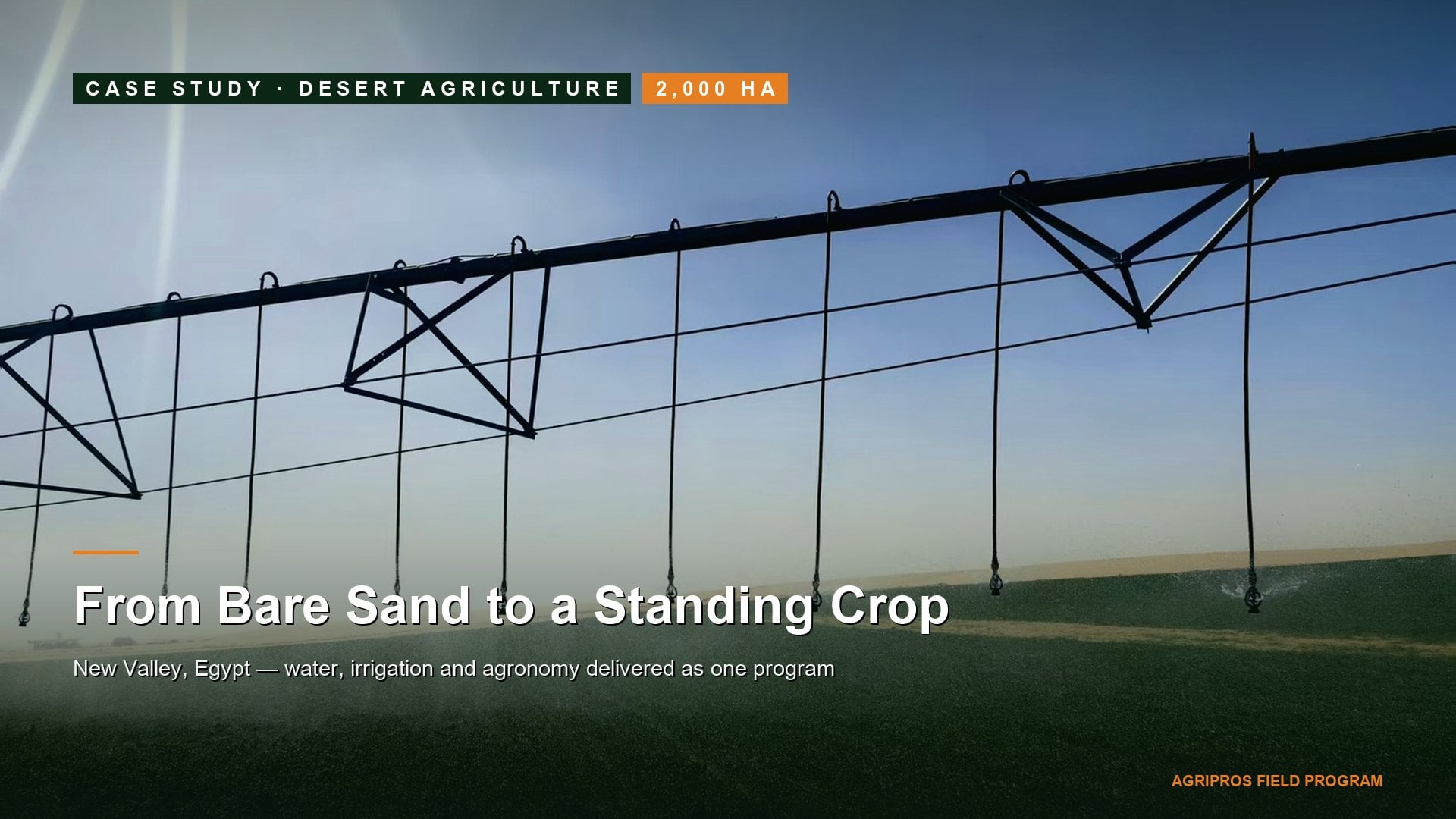
A first-season desert farm in Egypt's New Valley — water, irrigation and agronomy delivered as one program, not a chain of separate vendors.
01 Executive Summary
2,000 hectares of open desert, one first-season wheat crop.
A large-scale desert farm in New Valley Governorate, Egypt, set out to convert open desert into productive farmland. There was no water supply on site, no irrigation and no seedbed — and the nearest workshop, laboratory and agronomist were hours away.
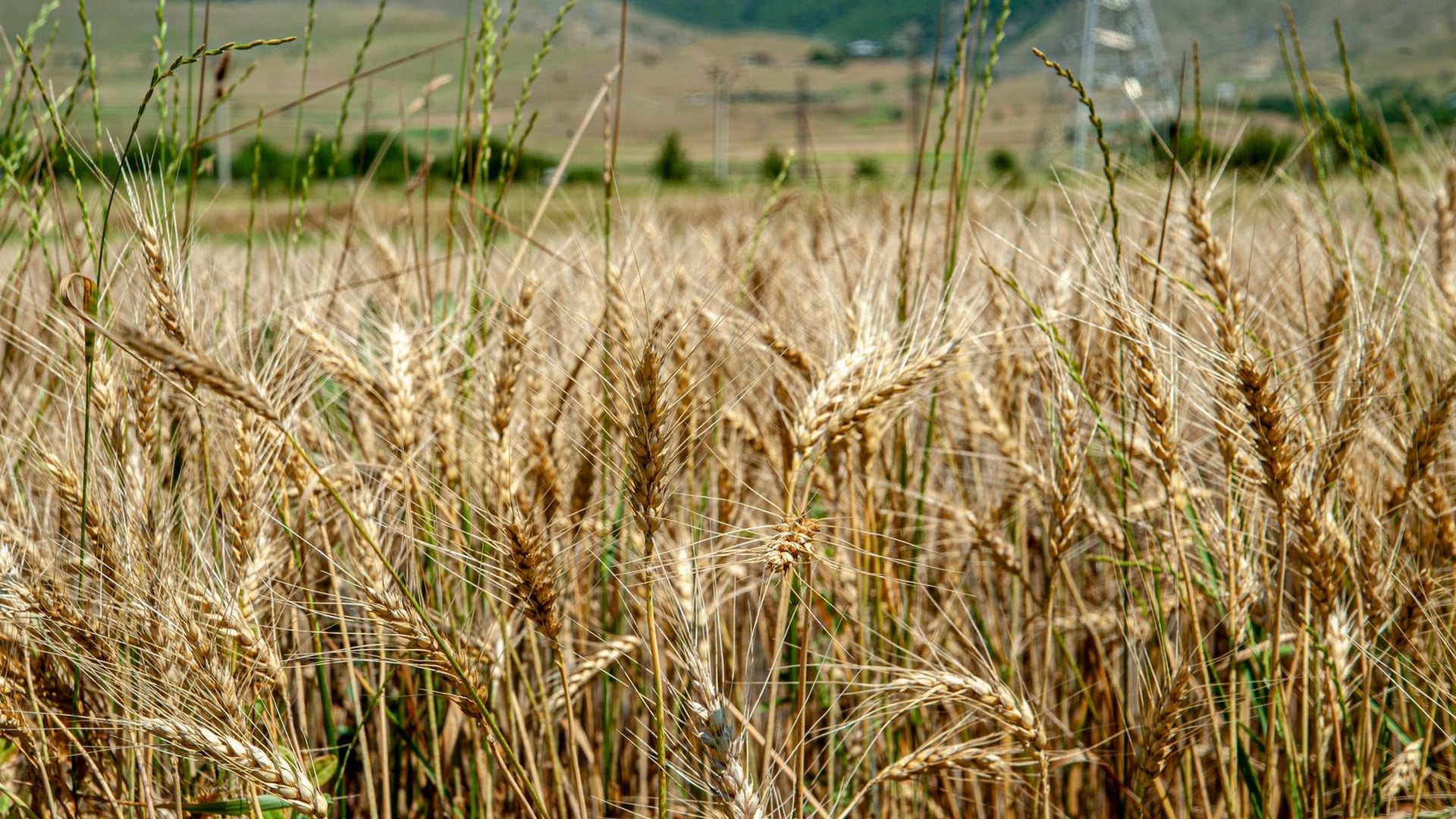
Agripros delivered four dependencies as one sequenced program — groundwater wells, center-pivot irrigation, seedbed preparation and seeding, and an on-site field service base — with an acceptance check at each stage before the next began. The first winter wheat crop was established across the development, and the farm entered its second season with service capability already inside the project.
The result was not a machine sale. It was a repeatable operating model for desert land, extendable plot by plot in the seasons that follow.
PROJECT AT A GLANCE
- 2,000 ha development area (≈4,760 feddan)
- 4 dependencies — water · irrigation · soil and seed · service
- 4 phases, each signed off before the next
- First season cropped area — to be supplied by the project team
02 Client Background and Challenge
A first-season farm with no room for a failed establishment.
The client is a large-scale agricultural developer bringing desert land in Egypt's Western Desert into production. New Valley Governorate — الوادي الجديد, the country's largest governorate by area — is open sand with no existing infrastructure on the plots.
Season one carried the full capital commitment with no harvest history behind it. A crop that failed to establish would not be a delay on a schedule; it would write off a year and the capital already committed to land preparation, water and equipment.
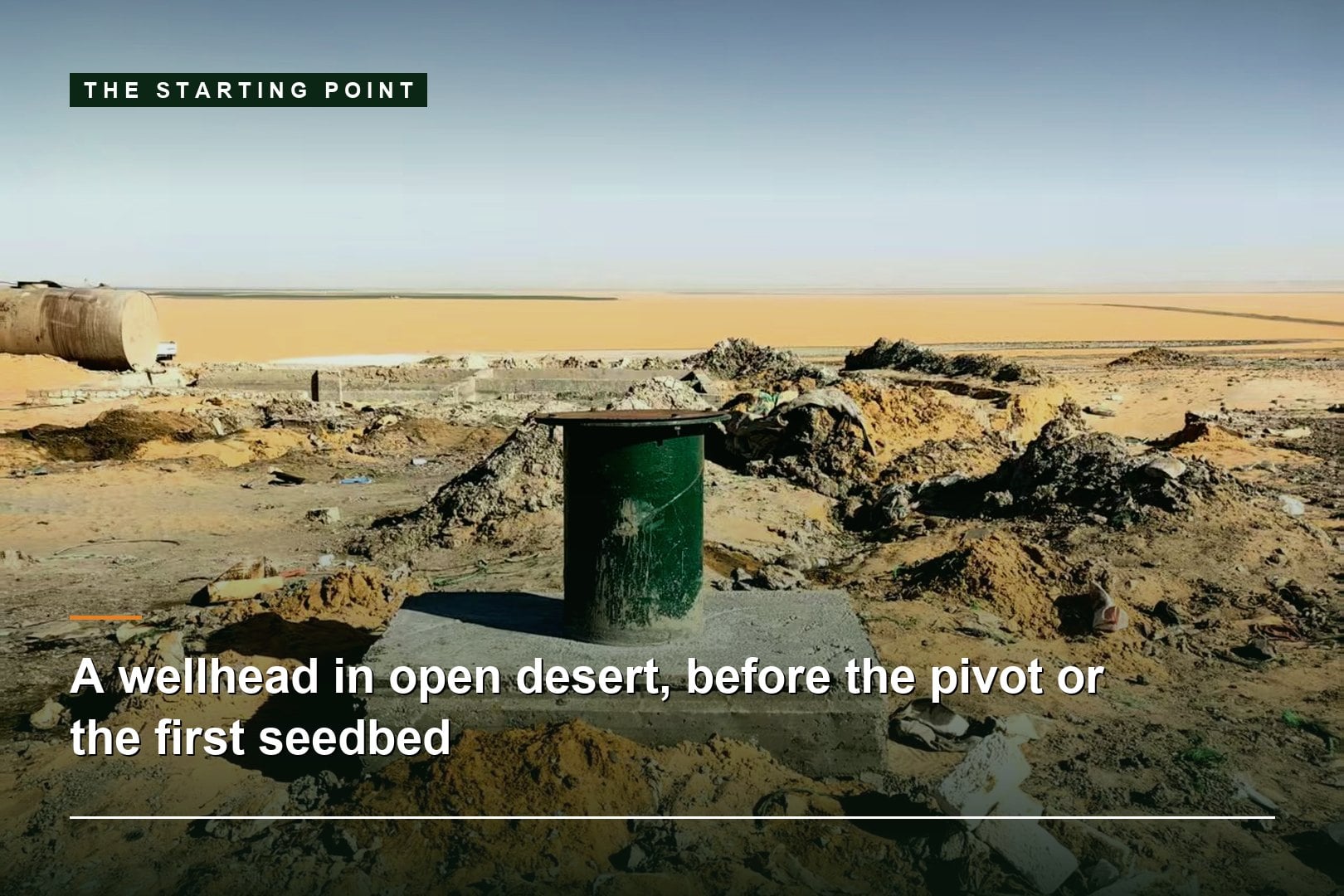
Water comes first, and it has to be proven. No land work, no equipment order and no planting date is meaningful until a reliable aquifer yield is confirmed. Drilling, pump sizing and water quality testing set the ceiling for everything that follows.
Sand does not hold a seedbed. Open desert has no structure, almost no organic matter and no moisture reserve. Germination depends on preparing the surface correctly and applying water in the right sequence — not simply on sowing more seed.
Distance turns small faults into lost seasons. With the nearest workshop, laboratory and agronomist hours away, equipment reliability and on-site service decide the outcome. A breakdown during establishment is not a delay; it is a failed season.
03 Why This Program, Not Three Suppliers
Buying water, irrigation and seed separately was the bigger risk.
Desert projects fail in the gaps between suppliers. A well contractor, an irrigation dealer and a seed supplier can each meet their own specification while the field still fails — and the failure only shows up after sowing, when the cost of correction is highest.
The client's decision came down to who would own the interfaces. Three separate contracts would have left the well-to-pivot and pivot-to-seedbed hand-offs unowned. A single program put one field team on one sequence, with an acceptance point before each stage was allowed to start.
What that structure required in practice: equipment specified for abrasive sand, high evaporation and variable water quality rather than adapted to it later; a full-cycle supply line — seeding through harvest — so the same partner remains accountable after the first crop; and a service base inside the project, bringing the workshop and the agronomist to the field instead of a flight away.
INTERFACES OWNED BY ONE PROGRAM
- Each stage meets its own spec; interfaces between them are unowned
- One sequence: water proven → pivot commissioned → seedbed prepared → sowing
- Mismatches surface after sowing, when correction costs most
- Acceptance check at every phase before the next one begins
04 Our Solution
Four workstreams, one operating system.
Each workstream had its own deliverable and its own acceptance check — and each one depended on the one before it.
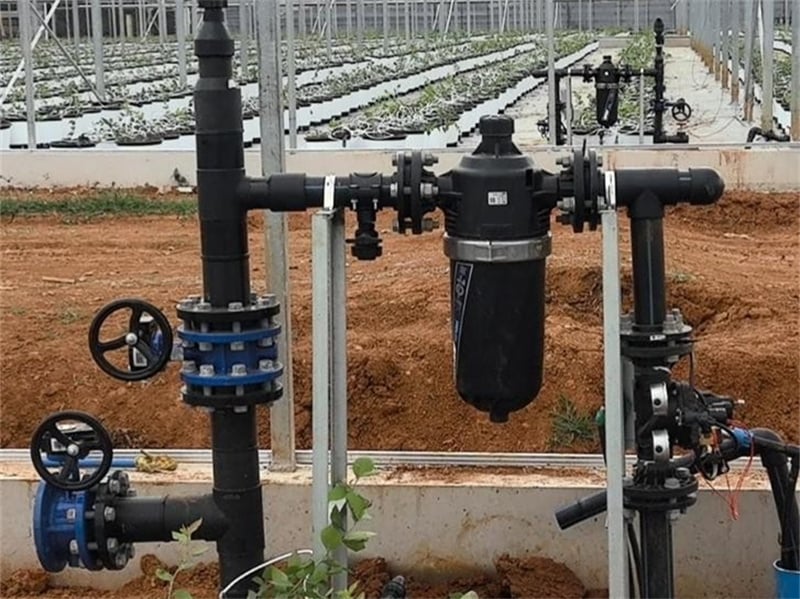
Water security. Well siting, drilling and pump selection, followed by water quality testing. The objective was not simply to find water, but to confirm a yield and quality the irrigation plan could rely on season after season.
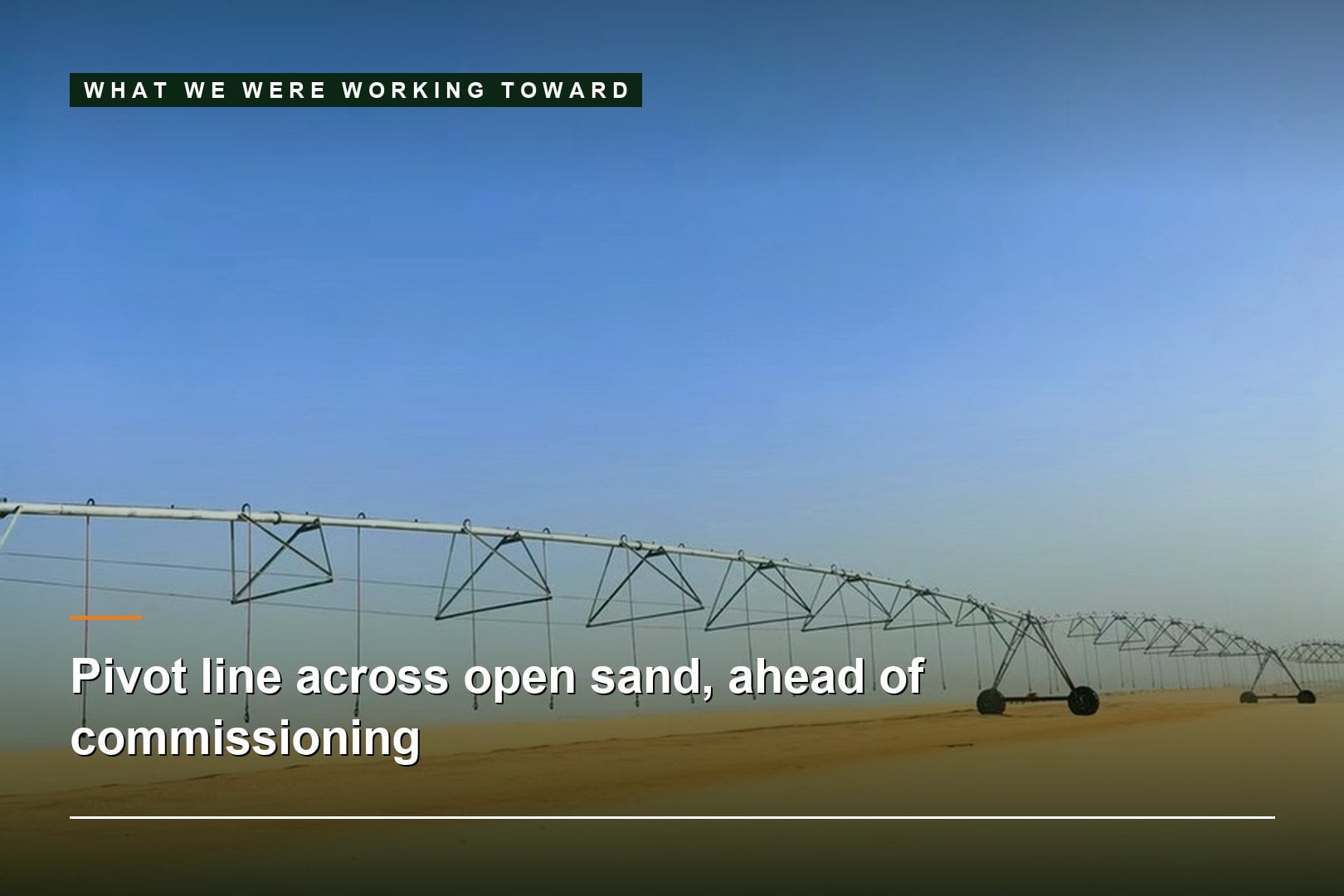
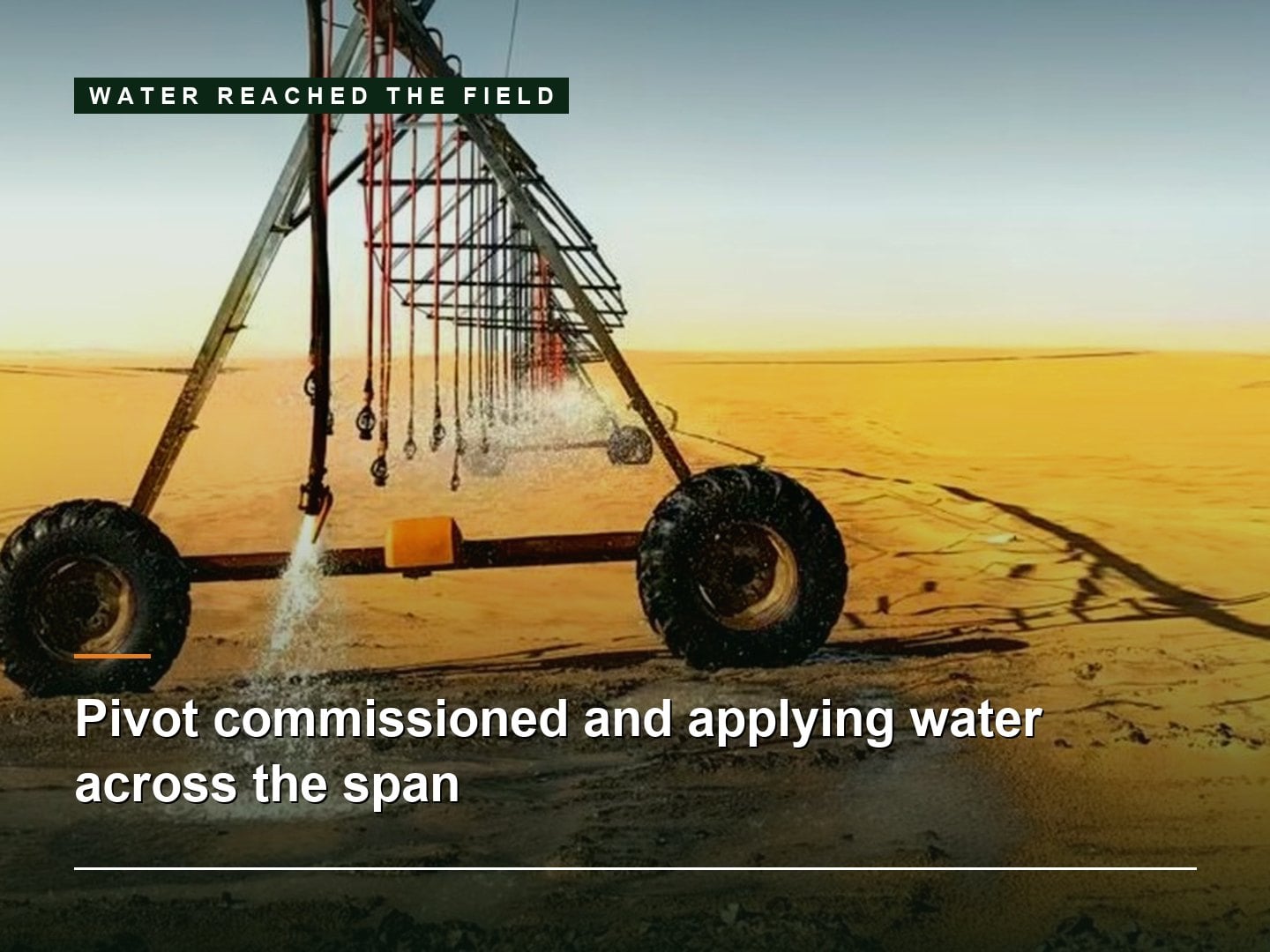
Irrigation built for sand. Center-pivot systems specified around the confirmed well yield, with the sprinkler package, pressure and application rate matched to sandy ground and high evaporation. Each line was aligned, commissioned and checked across its full span before planting.
Agronomy and establishment. Soil testing, land preparation and seeding were planned around the irrigation schedule. The field team monitored emergence across the pivot span and adjusted watering rather than waiting for a visible problem.
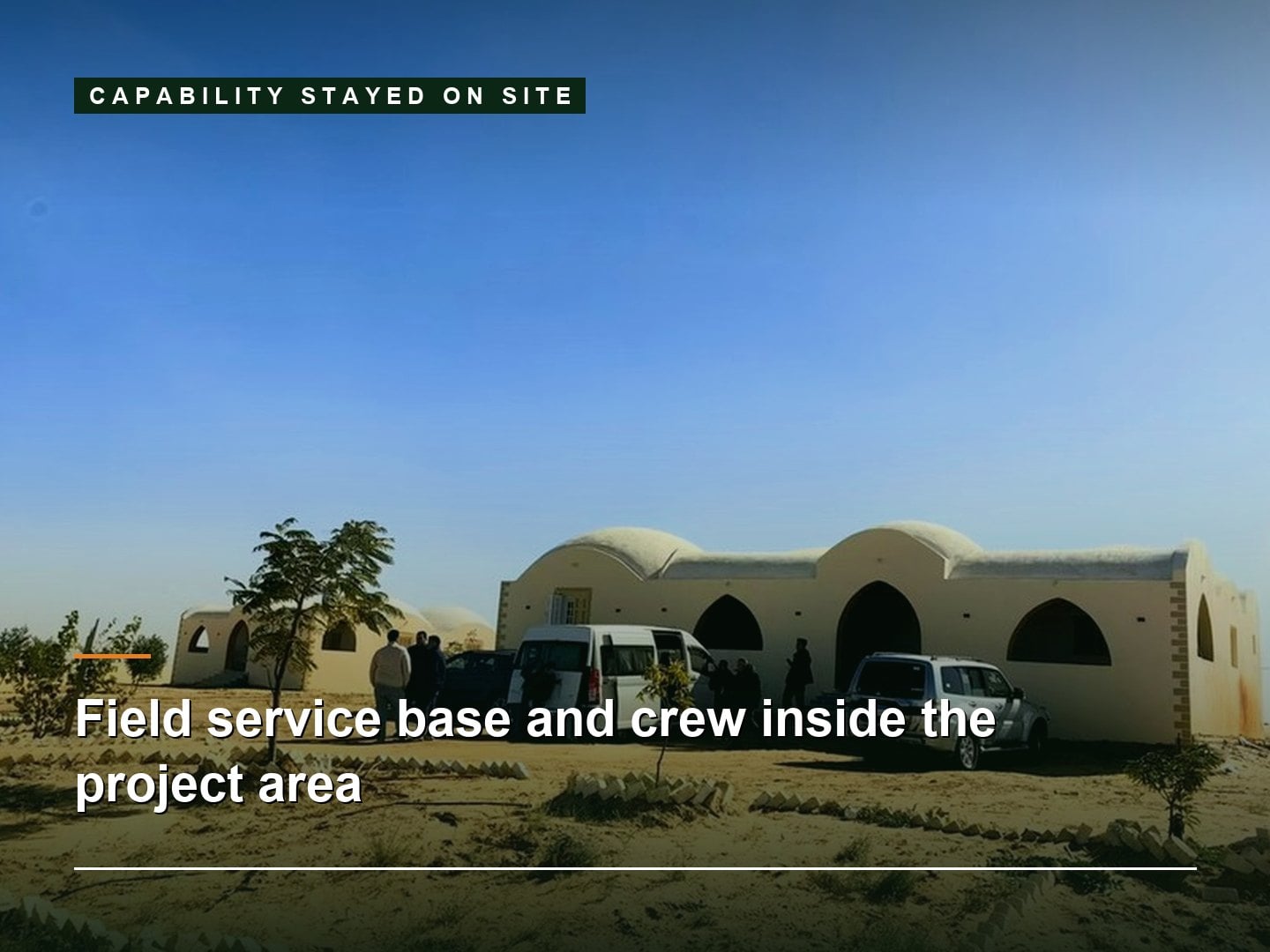
Field service and local capability. A service base was set up inside the project area to support maintenance, spare parts and day-to-day agronomy. The next season should not depend on a new mobilization.
TECHNICAL HIGHLIGHTS
- Water proven before specification — yield and quality tested before the pivot was specified
- Pivot matched to sand — sprinkler package, pressure and application rate set for abrasive sand
- Seedbed tied to the watering plan — soil test and seeding rate scheduled against the irrigation sequence
- Emergence monitored across the span — watering adjusted rather than waiting for visible failure
05 Implementation and Collaboration
Four phases. Each one signed off before the next.
The program was sequenced so that no stage was built on an unproven assumption. That discipline matters more in desert conditions than anywhere else: a well that cannot sustain the pivot, or a pivot that cannot cover the plot evenly, only reveals itself after the seed is in the ground.
Phase 01 — water proven. Wells sited and drilled; pumps selected; yield and water quality tested before land preparation began.
Phase 02 — land and irrigation. Plot prepared, pivots assembled and aligned, sprinkler package checked, system commissioned across the full span.
Phase 03 — first planting. Seedbed prepared and sown in step with the irrigation schedule; emergence monitored across the plot.
Phase 04 — handover and service. The field service base was brought into operation so the next season can be supported from inside the project area.
HOW THE PROJECT WAS RUN
- One plan, one field team — water, irrigation, soil and seeding worked to the same sequence
- An acceptance point per phase — the well before the pivot, the pivot before sowing
- Handover that outlasts the handover — service base, spares and crew left in place
06 Measurable Results
What changed on the ground.
A desert development is judged at field level: whether water arrives, whether it arrives evenly, and whether the farm can run a second season without starting over.
Water. No supply on site became a tested well connected to the system. Irrigation. None became center-pivot commissioning across the plot. Seedbed. Open sand became tested, prepared and sown ground. Support. Remote suppliers became an on-site service base and crew.
Season-one figures — yield per hectare, irrigation water per hectare against a flood baseline, the number of wells and pivots commissioned, and the share of the development cropped in the first season.
07 Related Machinery
Equipment categories behind a project like this.
Agripros supplies the full field-to-processing line. These are the categories most relevant to a 2,000-hectare wheat development.
Seeders & Transplanters — precision wheat establishment: seeding rate, depth and uniformity across the field.
Irrigation Systems — center pivot, drip and water delivery for sand and high-evaporation conditions.
Tractors — land preparation, seeding support and haulage matched to plot size and soil.
Sprayer & Fertilizer — crop protection and granular top dressing across large contiguous blocks.
Harvesters — wheat harvest and grain handling for large, desert plots.
08 Next Step
Planning a farm where the water has to be built, not assumed?
Send us the location, the land area and your target crop. We will come back with the water-first sequence, the irrigation specification and the field-service plan this project was built on.
WHY AGRIPROS
- Full-cycle range — seeders, tractors, harvesters, irrigation and processing from one supplier
- Export-ready — configuration, documentation and spare parts for projects across 40+ countries
- Service on the ground — on-site crew, operator training and spare-parts stock after delivery
 EN